Prepared by: Sherif Mourad
Arabi Facts Hub
is a nonprofit organization dedicated to research mis/disinformation in the Arabic content on the Internet and provide innovative solutions to detect and identify it.
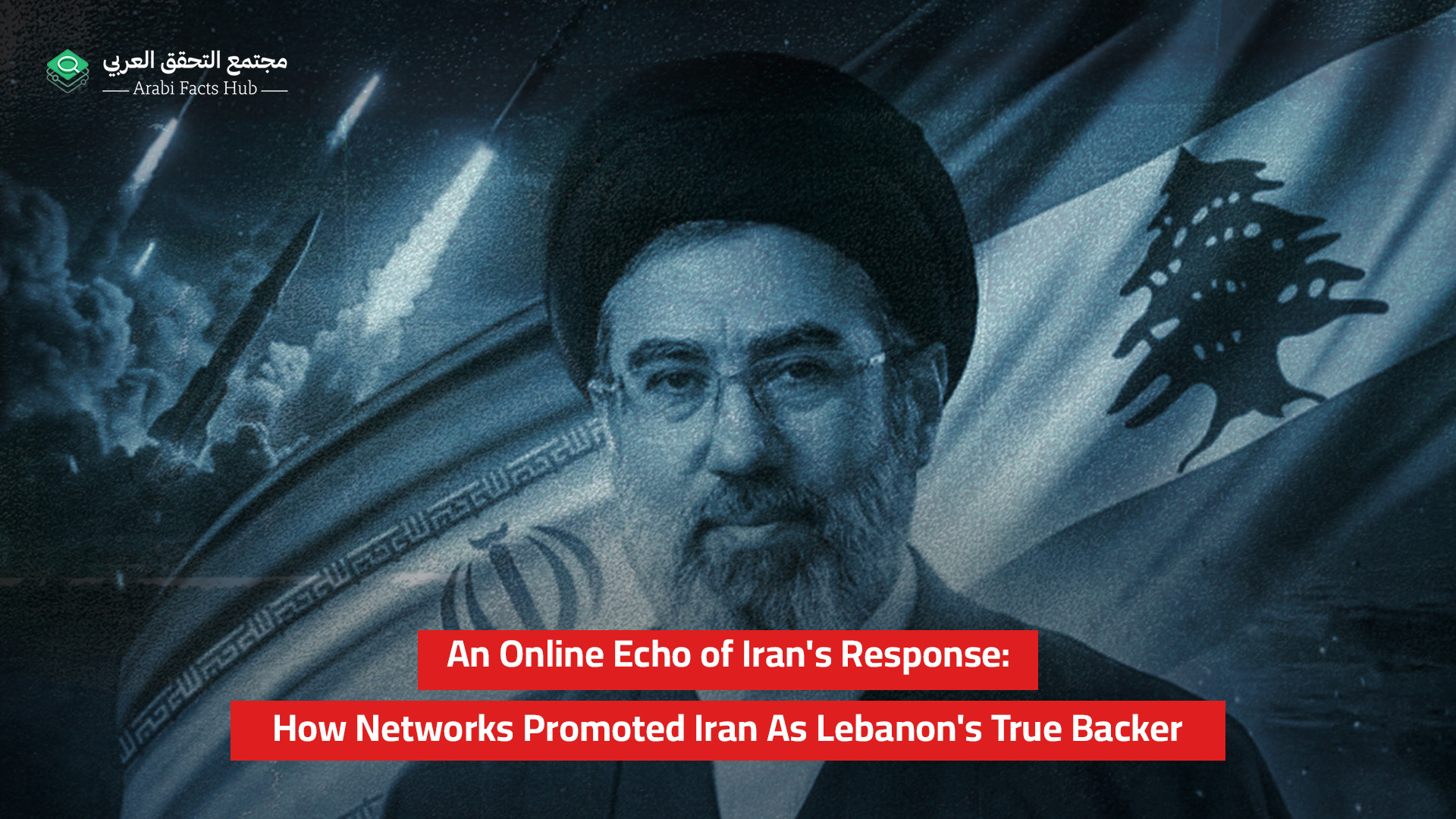
Following the Israeli bombardment of Beirut's Southern Suburb, the Iranian response sparked digital mobilization among pro-Hezbollah and pro-Iran communities on X. Beyond celebrating the strike as a military action, many users framed it as symbolic proof that Tehran has not abandoned Hezbollah or Lebanon to face Israel alone.
Hashtags emerged such as #العصف_المأكول (Crushed Enemy), #الرد_الايراني (Iran’s Response), and #ساده_عند_الولي_الفقيه (Masters in the Eyes of Al Wali AlFaqih), accompanied by expressions of gratitude to Iran, references to the "Unity of Fronts," and narratives that considered the Iranian response a rebuttal to the discourse opposing Hezbollah—particularly accusations that the party had entangled Lebanon in the confrontation or was left alone during it.
This piece does not seek to evaluate the Iranian response militarily or analyze the political parties' positions; rather, it aims to examine the digital behavior that followed the event. Does this wave reflect organic interaction within an environment supporting Hezbollah and Iran, or do the data reveal indicators of coordinated amplification or inauthentic behavior that contributed to pushing the discourse of gratitude to Iran within the public discussion on X?
To answer this question, we analyzed a sample of posts associated with the three hashtags, focusing on the period following the Iranian response. We tested three levels of evidence: the volume of reach and interaction, the repetition of narratives and phrases, and the network structure of relationships between accounts and hashtags, including textual similarity and temporal synchronization between the posts.
Research Question
Do the data reveal coordinated amplification of pro-Iran gratitude discourse following the Iranian response to the bombardment of the Southern Suburb, or do they primarily indicate organic rhetorical mobilization within a digital environment supportive of Hezbollah and Iran?
What We Examined
The analysis relied on data extracted from the Brand Mentions tool regarding three hashtags associated with the digital wave that followed the Iranian response:
The analysis focused on posts that appeared from June 7, 2026, as this timeframe is closest to the Iranian response and the subsequent interaction on the "X
The core sample included 78 posts, published by approximately 58 accounts, achieving an estimated reach of nearly 1.19 million users, along with about 4.7 thousand interactions.
Because the "Crushed Enemy" hashtag was active prior to the incident referred to as Iran’s response, the analysis did not treat the full historical volume of the hashtag as part of the response wave. Instead, a distinction was made between the general activity prior to the hashtag and the posts closest in time to the event, to avoid conflating prior online activity with the wave that immediately followed the incident in question.
To examine whether the wave reflects organic mobilization or indicators of coordinated amplification, the analysis tested three levels of evidence: volume of reach and interaction, repetition of narratives and phrases, and the network structure of relationships between accounts and hashtags, including textual similarity and temporal synchronization between posts.
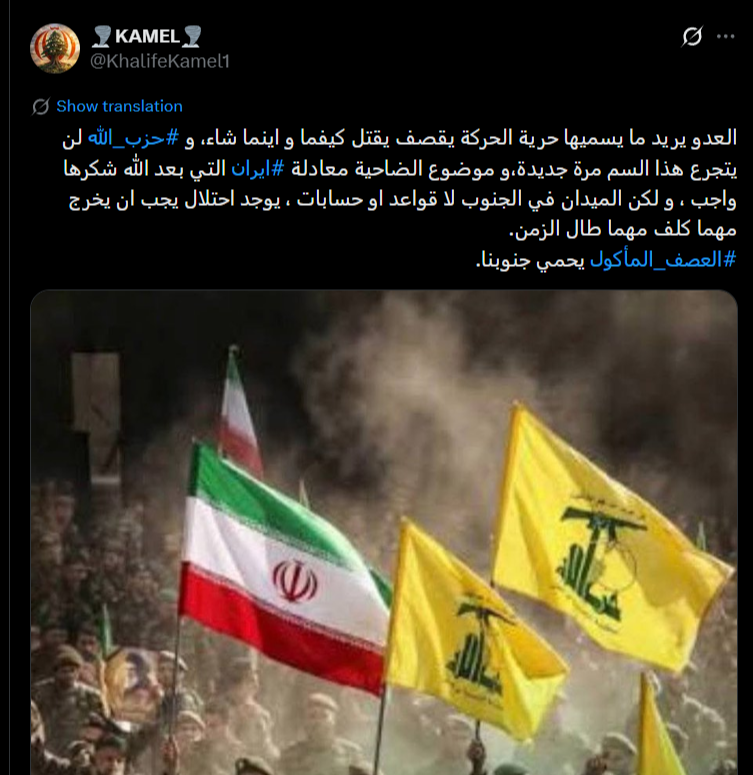
The data does not point to a massive online wave in quantitative terms. In the window focused on by the analysis—from June 7 onwards—the sample recorded 78 posts published by nearly 58 accounts, achieving an estimated reach of about 1.19 million, along with around 4.7 thousand interactions.
When narrowing the time window to the period immediately following the Iranian response, the sample size decreases to about 58 posts, published by nearly 42 accounts, with an estimated reach of about 709,000 and around 3.1 thousand interactions. This difference gains methodological importance because the “Crushed Enemy” hashtag was active before the incident dubbed “the Iranian response” and did not appear for the first time with it. Therefore, the entire activity associated with the hashtag cannot be treated as a direct reflection of the response; rather, a separation should be made between the hashtag’s prior history and the wave that followed the event.
Limited volume does not reflect reduced significance however. The wave was associated with a sensitive regional event represented by the bombardment of the Southern Suburb, then the Iranian response, followed by controversy over the position of Hezbollah and Iran in the confrontation with Israel. In this context, the posts did not appear merely as a fleeting celebration of a military strike, but as an attempt to re-establish a specific political message: that Iran is still present in the confrontation, and that Hezbollah and their supporters have not been left alone.
The discourse within the sample took on a densely political and symbolic character. Phrases frequently appeared thanking Iran, describing it as "Lebanon's true backer," or linking the Iranian response to the defense of the Southern Suburb. The term "Unity of Fronts" was also present as a framework connecting Lebanon, Iran, and the confrontation with Israel into a single path, in contrast to opposing narratives that accused Hezbollah of entangling Lebanon in a war it cannot afford, or suggested that Iran abandoned its allies in a moment of danger.
In this sense, the core message of the wave was not just that Iran responded, but that "Iran did not abandon Lebanon. This idea formed the axis of the narrative pushed by the posts, as the Iranian response within the sample was presented as proof of loyalty to an ally, a rebuttal to discourses questioning the utility of an alliance with Tehran, and a reaffirmation of the interconnectedness of confrontation fronts with Israel.
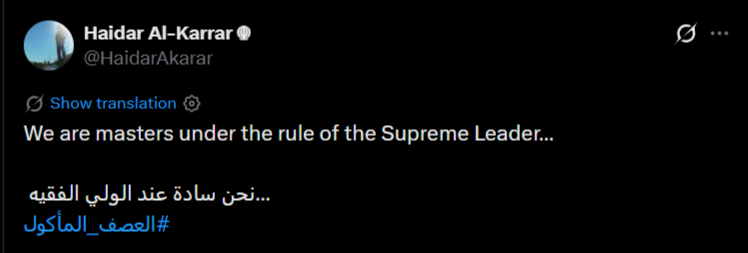
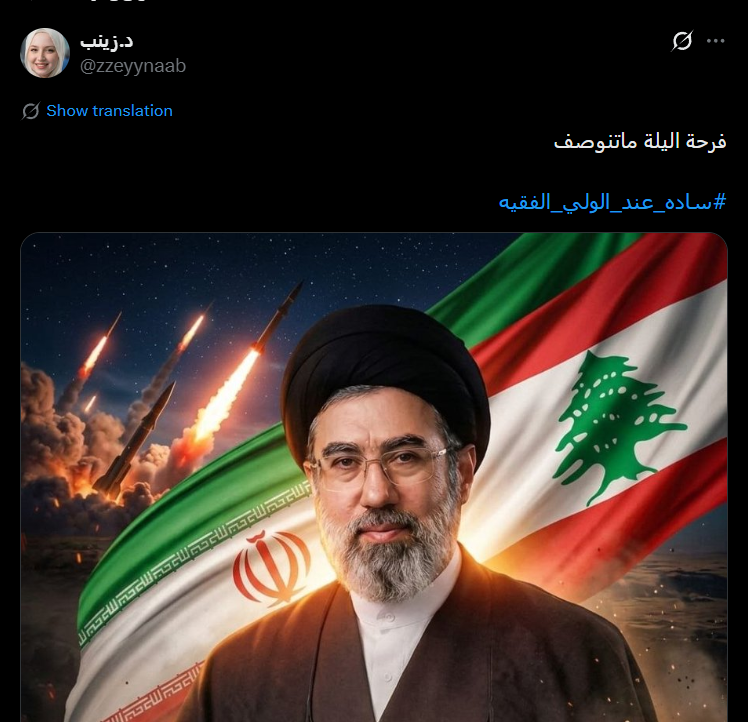
The hashtag “Masters In the Eyes of Al Wali Al Faqih” also appeared within part of this discourse, not as a broad hashtag in itself, but as a condensed ideological and political expression within a segment of the community supportive of Hezbollah. The celebration of the "Wali al-Faqih" did not come here merely as a religious slogan, but as a sign of political and symbolic belonging to an axis that sees Iran as an authority and a backer in the confrontation.
Accordingly, the importance of the wave lies in the intersection of two factors: first, that it was not large enough to be described as a widespread mass campaign, and second, that it used clear political language to reinforce a specific narrative at a highly sensitive regional moment. This makes it worthy of examination, not as a massive trend, but as a case of online mobilization around a specific political question: Does this celebration reflect organic interaction within a environment supportive of Hezbollah and Iran, or are there indicators of coordinated amplification pushing the "Iran did not abandon Lebanon" discourse into the public discussion?
The analysis of the sample showed that the wave was not evenly distributed among a wide number of users. Although the monitored posts came from dozens of accounts, the digital impact was highly concentrated among a limited number of accounts with the highest reach and interaction.
According to the sample data, the top ten accounts achieved about 75% of the total estimated reach of the wave, and these same ten accounts accounted for nearly 85% of total interactions. This percentage reveals that the spread of the wave did not rely on broad horizontal participation as much as it relied on a few accounts capable of pushing the discourse to a larger audience.
To test this, we conducted a network analysis of three levels of relationships between accounts and posts. The first level represented the network of accounts and hashtags, to examine whether the same accounts were moving across the three hashtags: “Crushed Enemy”, ”Iran’s Response”, and “Masters in the Eyes of the Supreme Leader.” The second level represented the network of similar vocabulary, to monitor whether different accounts were reposting identical or near-identical texts. The analysis utilized a composite evidence network as its third level of evaluation, which integrated temporal synchronization, textual overlaps, and the shared deployment of hashtags.
In the network of accounts and hashtags, a wide rhetorical connection appeared between accounts through shared hashtags. The network included 146 nodes and 192 edges, covering 61 accounts and 85 hashtags. The #العصف_المأكول (Crushed Enemy) hashtag emerged as the central tag in the network, used by 37 accounts and appearing 48 times, with an estimated reach of nearly 968,000. In contrast, #الرد_الايراني (Iran’s Response) appeared among 19 accounts, with 25 mentions and a reach of nearly 153,000, while #ساده_عند_الولي_الفقيه (Masters in the Eyes of the Supreme Leader) remained smaller in size, appearing among only 8 accounts, with 10 mentions and a reach of nearly 88,900.
This result reveals that “Crushed Enemy” acted as a rhetorical bridge that brought accounts supportive of Hezbollah and Iran together within a single political sphere.
The composite evidence network—integrating shared hashtags, textual overlaps, and temporal synchronization—comprised 61 nodes and 58 edges. However, its structure was notably fragmented, consisting of 30 distinct components. The largest of these clusters contained only 23 accounts, while 24 accounts remained entirely isolated. Such a decentralized layout contrasts with what would be expected from a highly coordinated campaign, which typically features a large, cohesive central core linked by multiple indicators of synchronized behavior; instead, this wave appeared significantly more disjointed.
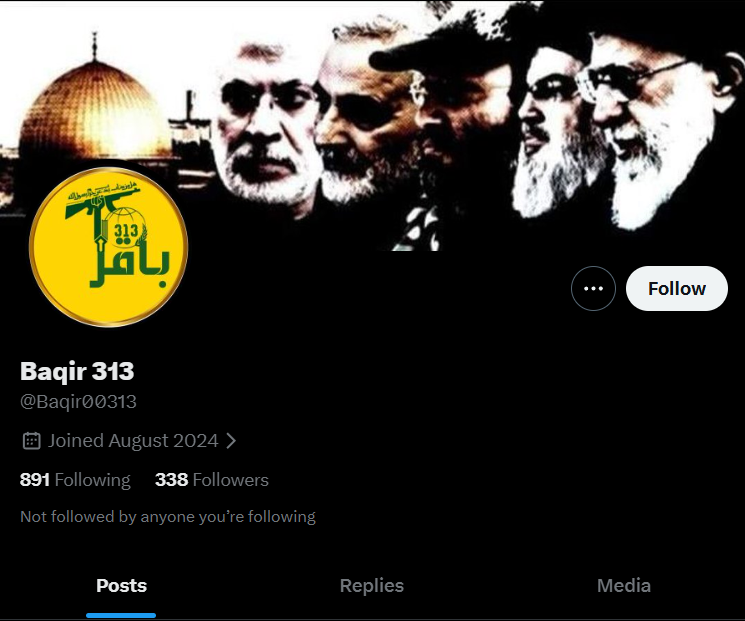
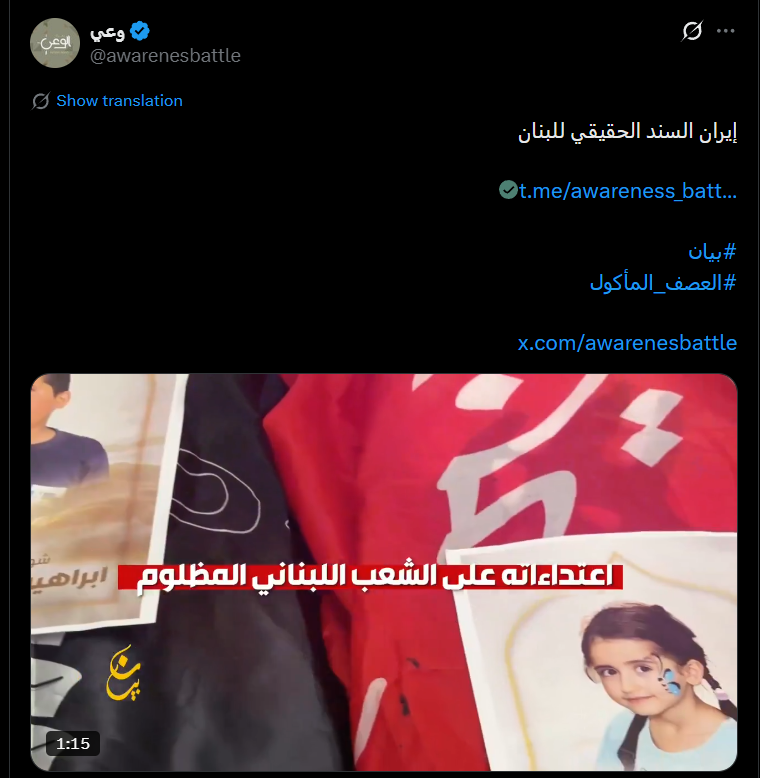
Nevertheless, the analysis is not devoid of limited indicators that deserve attention. The pair of accounts Maryam33856 and ahmed buf appeared with similar text and a close bundle of hashtags, including #العصف_المأكول (Crushed Enemy), #انا_علي_العهد (I Remain Loyal), and #شكرا_ايران_الوفاء (Thank You Loyal Iran) with a short time difference in posting. Likewise, the pair of accounts Baqir00313 and Awareness Battle appeared with text close to the phrase "Iran is Lebanon's true backer," with temporal synchronization and proximity in the narrative associated with the hashtags “Masters in the Eyes of the Supreme Leader,” and “Crushed Enemy.” In addition, the bundle “Thank You Loyal Iran” appeared among a small group of accounts, including Maryam33856, ahmed_buf, haidar2soha, and MahdiAlzaim.
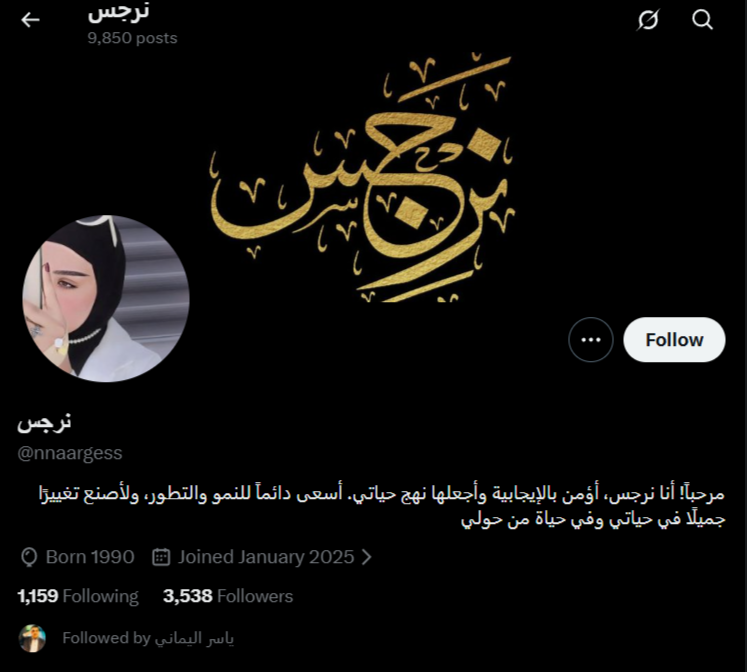
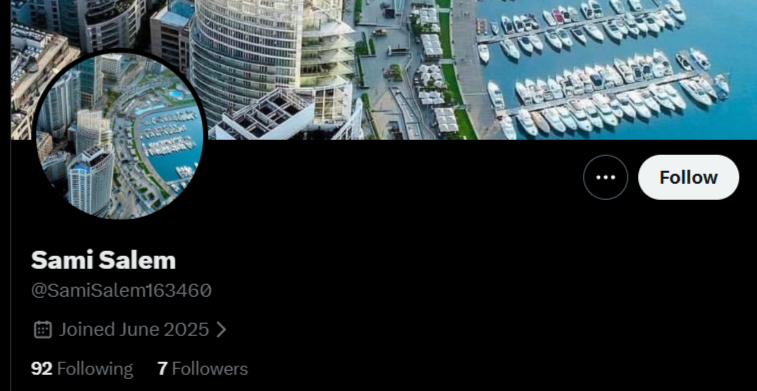
However, these indicators remained limited in scope. They point to the recycling of some phrases and narratives, and perhaps to localized coordination between a small number of accounts. Notably the highest-reaching accounts, such as samerhajali, Alhamad_7OCT, ihoussama, Ishk2000, HassanMontanaT, and pouutivar, clearly contributed to extending the scope of the wave.
Accordingly, it can be said that the amplification came partially through high-reach accounts, but the available data does not show that these accounts acted as a coordinated network. What the results reveal is the existence of online mobilization within an environment supportive of Hezbollah and Iran, whose impact was expanded through a limited number of high-reach accounts, and within which small pockets of textual similarity and synchronization appeared, but it did not turn into a central operating network or a single block of accounts moving collectively across the three hashtags.
Prepared by: Sherif Mourad