Arabi Facts Hub
is a nonprofit organization dedicated to research mis/disinformation in the Arabic content on the Internet and provide innovative solutions to detect and identify it.
Building Capacity in a Time of Digital Chaos: How Arabi Facts Hub Works with Media Students and Journalists to Rebuild Trust in Information
Dec. 17, 2025 | AFH
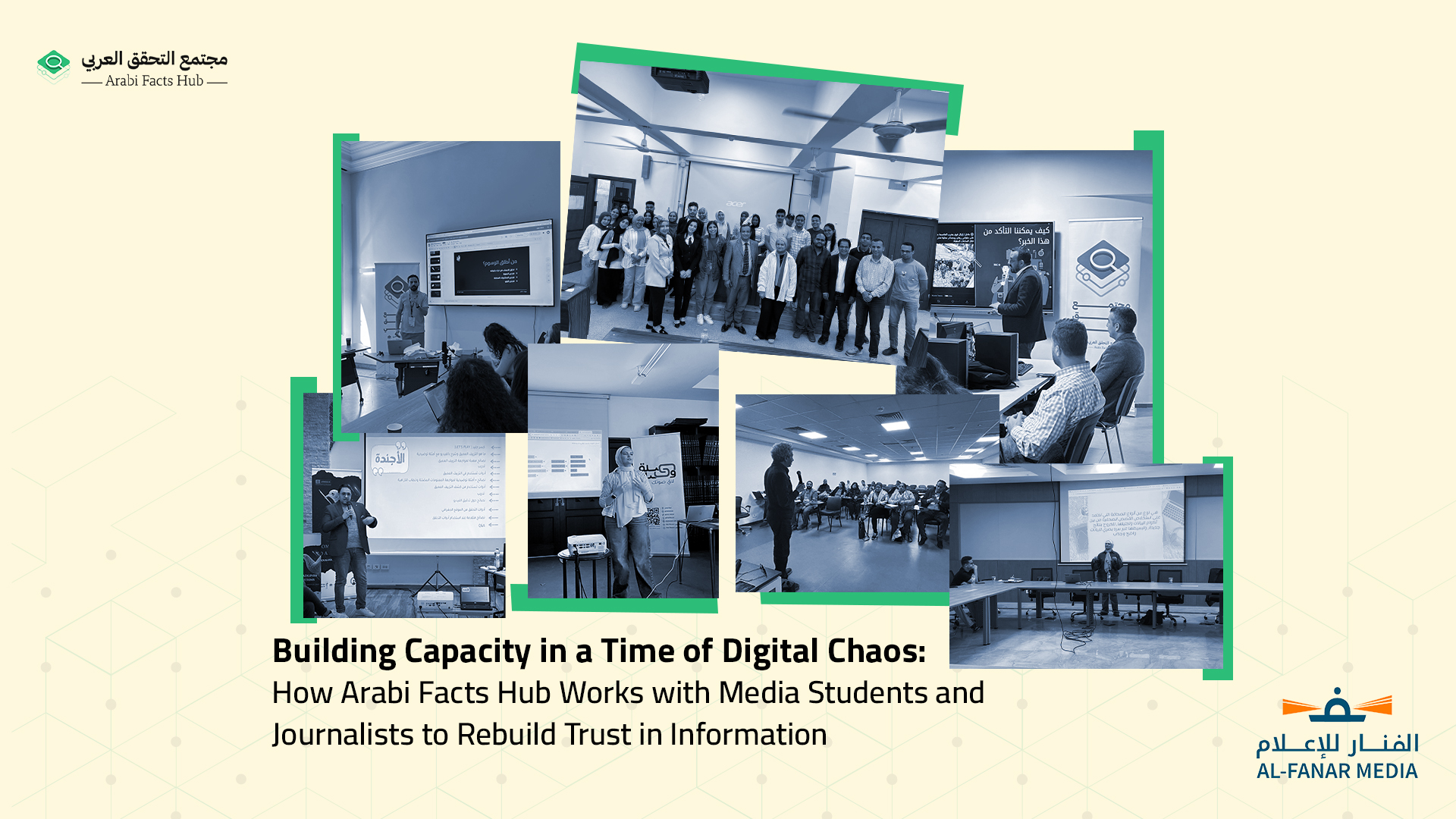
This educational article is published in collaboration between Arabi Facts Hub (AFH) and Al-Fanar Media
In recent years, the shape of the digital space in the Arab world has changed at an enormous speed. The internet has evolved beyond a simple platform for communication and news. It is now a constant, open flow of information—a continuous mix of truth and falsehood, fact and opinion, raw data and its interpretation. This immense volume has created a new challenge for journalists, media students, and fact-checkers in the region: How do we know what we read is real? How can we consciously practice journalism in a world where change outpaces the speed of educational systems? And how do we catch up with the development of journalistic methods around the world?
These legitimate questions were the starting point for an extensive journey that AFH began more than 4 years ago—one that has encompassed not only technical development, but also significant cognitive and human dimensions. The goal is for every student, journalist, and content creator to be able to read the digital scene with a critical eye, and to carry modern tools that protect them and their audience from the waves of disinformation sweeping across social media platforms.
While the magnitude of disinformation today might seem greater than the capabilities of any single person, building collective awareness always begins with a small group of educated, trained, and conscious individuals. This article explores the mission of Arabi Facts Hub: how it utilizes cutting-edge technology and training to foster a new media and information culture across the Arab region. It examines the AFH's methodology, its engagement with Egyptian and Arab universities, the challenges encountered, and the connections established between these efforts and the media job market.
Genesis: When Disinformation Becomes the Rule, Not the Exception
The spread of false information is no longer a fleeting event in the Arab world. The digital landscape coincides with political transformations, humanitarian crises, wars, public opinion issues, and intensive interaction on social media. In many of these contexts, misleading content becomes part of the narrative industry, whether through organized campaigns, AI-generated content, or inaccurate news that spreads unintentionally.
This is where our story begins. Arabi Facts Hub was founded with the unique goal of developing a new perspective on the information disorder landscape. This approach is built on two core components: the use of large language models and the creation of the region's most comprehensive database. This extensive database integrates the work of numerous vital, independent verification initiatives. These initiatives have formed a research alliance to collaborate with AFH. Their collective objective is to analyze disinformation patterns using AFH's open-source database, providing a critical resource for all researchers, journalists, and academics seeking to understand and navigate this complex environment.
Additionally, AFH has established an investigative unit to monitor inauthentic behavior and coordinated campaigns on social media. This is crucial for exposing the techniques used to sway public opinion and carry out digital manipulation for political, economic, and social objectives.
This leads to a central question for students and young journalists:
”
How can I establish my professional stance amid this chaos?
“
This question is what motivated Arabi Facts Hub to focus its efforts on universities. These institutions are vital because they are where the foundational traits of future journalists are shaped—where they acquire their initial skills, develop professional practices, and establish their perspective on the media's role in serving society. This is where the role of capacity development and enhancement programs aimed at serving the journalistic community in the region came in.
AFH’s Methodology: Building Awareness Before Tools
From its inception, AFH has operated using a core, yet simple, methodology that can be summarized as follows:
1- Awareness First, Before Tools and Application
The real challenge is not in teaching tools, but in changing the way of thinking:
- How do we ask questions?
- How do we intelligently doubt?
- How do we distinguish between an opinion and a fact?
- How do we analyze what is behind the text, image, and video?
2- Applied Training, Not Theoretical Lectures
Arabi Facts Hub believes that digital literacy is not taught on a whiteboard, but through experience.
Therefore, every training session comes with practical exercises, analysis of posts, examination of images and videos, and use of verification tools.
3- Integration of Storytelling, Data, and Artificial Intelligence
At AFH, we are committed to equipping university students with essential skills for the modern job market: the ability to construct compelling stories, substantiate them with credible facts and data, and safeguard their work against disinformation.
4- The Trainee Must Be Part of the Solution
The goal is not for the student to receive ready-made knowledge, but to leave the training capable of applying what they have learned in their future work and in their life in general.
AFH’s Journey Inside Egyptian Universities
Since the launch of our university program, Egyptian universities have become a key destination for us to achieve the goal of spreading the culture of information verification. We have trained around 350 male and female students in 4 Egyptian universities, starting from Alexandria in the Arab Academy for Science, Technology & Maritime Transport (AASTMT) and reaching Suez, Helwan, and Al Galala. Our journey is still ongoing.
Arab Academy for Science and Technology
We started with intensive training for students of the College of Language and Media at the AASTMT in Alexandria, which combined storytelling, fact-checking, and data journalism. Tens of students and faculty members participated in the training, which included practical applications that helped students grasp how to build a tightly structured digital journalistic story, across three sessions: "Digital Storytelling and Techniques for Story Construction," "Fundamentals and Tools for Fact-Checking AI-Generated Information," and "The Essential Toolkit for the Data Journalist."
Our educational journey then moved to Galala University in the Suez Governorate, where AFH broadened its training curriculum to include a focus on understanding AI-generated content and detecting deepfakes—skills that are both contemporary and scarce in Arab educational settings. This is part of our comprehensive vision to bridge the gap between theoretical education and practical application in media colleges, and to provide professional training that enhances students' readiness for the demands of the current journalistic job market.
The training session for students at Helwan University in Cairo was a remarkably well-attended event, drawing hundreds of participants. This strong showing underscored a critical need for universities to establish programs that bridge the gap between academic study and the demands of the modern journalistic job market, particularly in data and content monitoring. The day's agenda featured two sessions, which successfully combined engaging interactive presentations with hands-on practical applications and stimulating open discussions, resulting in significant educational value for the students.
Returning to Suez Governorate, we focused our efforts this time on providing training to the students of the city’s public university. The training involved dozens of students, focusing on enhancing their fact-checking and digital storytelling abilities. Its goal was to familiarize them with cutting-edge techniques for creating journalistic content that is both reliable and impactful. The focus was on visual storytelling skills and collecting digital evidence, in addition to addressing fake content produced by artificial intelligence.
These trainings have led to significant progress, including the establishment of partnerships with six universities in Egypt, with potential for further expansion, and agreements with multiple universities in Libya, Lebanon, and Kuwait. This ongoing journey of bridging the divide between theoretical learning and practical skills will therefore include additional training sessions. Our goal remains to fully prepare university students for modern professions by opening wide the doors to the job market.
But the path was not without challenges
During the implementation of its training sessions in universities, AFH faced several obstacles that affected the workflow, most notably:
- The variation in digital skill levels among students, which required allocating extra time to raise the minimum competencies before moving to advanced content.
- Low awareness of the seriousness of disinformation within some academic institutions, which required greater effort to build a common understanding of the importance of verification.
- Limited time available in academic schedules, making the integration of verification sessions and the allocation of enough time for practical application a recurring challenge.
- A clear gap between what students study and what the contemporary journalistic job market needs.
- The need to update curricula and introduce new fields and tools that keep pace with the continuous development in digital verification.
Despite these challenges, AFH persevered. The unmistakable impact of the training—evident in the students' heightened curiosity, measurable skill improvement, and increased motivation for profound knowledge—justified the effort. We continuously track this success through the comments and observations students share in post-workshop surveys, which are essential tools for constant feedback measurement and benefit assessment. This ongoing follow-up process allows us to continuously improve and simplify the content, making sure it is clear and accessible to all students while accommodating their individual learning needs.
Regional Expansion: Taking Training Beyond Egypt Across the Arab World
AFH's influence has expanded significantly, moving beyond Egypt's borders to establish a solid regional presence across multiple Arab countries. In 2025 alone, our programs engaged approximately 500 trainees, including journalists, researchers, students, and media professionals. This comprehensive effort involved delivering 20 digital sessions and 21 in-person training sessions spanning Egypt, Lebanon, Jordan, and Iraq. These initiatives represent:
- Training journalists and fact-checkers in Algeria, Jordan, Mauritania, the Kurdistan Region of Iraq, Tunisia, and Lebanon.
- Implementing specialized quality programs for female Syrian journalists aimed at uncovering false narratives and disinformation techniques.
- Providing professional training within major media institutions such as the "Egyptian Journalists Syndicate," «Al-Masry Al-Youm» newspaper, and «Maspero».
- Building effective partnerships with regional initiatives like «Silat Wasl» and «Tahqqaq 360» in Lebanon, and the "Yemeni Archive" in Yemen.
- Participating in pioneering events across the region, most notably the "Khobz & Net 2025" conference in Lebanon.
- Implementing specialized training with UNESCO on hate speech, algorithms, and deepfakes.
This regional presence has contributed to cementing the status of the Arabi Facts Hub as an Arab platform where those working in the field of verification, relying on a scientific methodology and advanced tools based on artificial intelligence and data analysis, which opens the door to a wider impact and a network of cooperation that is not limited by geographical boundaries.
Why does all this matter? And how does it relate to the job market?
The skills that AFH trains on are no longer a luxury; they have become an essential part of any journalistic job today. Media institutions are no longer just looking for a journalist who writes well, but for a journalist who can:
- Understand data and deal with it intelligently.
- Use verification tools efficiently.
- Verify the authenticity of photos and videos before publishing them.
- Protect their institution from falling into disinformation.
- Write documented and engaging digital stories.
- Understand how algorithms and digital narratives affect the audience.
The contemporary job market demands precision, no longer tolerating mistakes or superficial and inaccurate work. This reality underscores the vital mission of Arabi Facts Hub: to help cultivate a generation of journalists and fact-checkers equipped with the confidence, knowledge, and up-to-date skills necessary to navigate a complex media environment effectively.
Beyond the Database: An Unprecedented Arab Research Project
AFH’s work is not limited to training; it extends to include building knowledge and research projects that enhance Arab understanding of information disorder. The most prominent of these efforts are:
- Establishing an open Arab database for misleading content, which is updated automatically on a daily basis, and currently includes 20,588 verification materials submitted by 24 partners from independent fact-checking organizations in 10 Arab countries.
- Issuing annual research monitoring the development of information disorder and false methods.
- Launching initiatives that support the development of digital policies and the improvement of the internet environment.
- Designing educational programs to enhance Media and Information Literacy (MIL) among students and the public.
The goal of these projects is to create a more aware, accurate, and transparent Arab media environment. They achieve this by integrating the community into a wider reform system that spans various sectors, including education, journalism, public policy, and the digital realm.
Summary of the Journey: Towards a Disinformation-Resilient Generation
Today, AFH constitutes an important platform for training students and journalists on the tools that protect society from information chaos.
Despite the obstacles, the experience in Egyptian and Arab universities has proven that students are thirsty for knowledge, and that Arab journalism can regain its role when it possesses the right tools.
This article is neither an advertisement nor solicitation, but an attempt to present a journey that began with a simple question:
”
How do we verify information in an era where disinformation has outpaced the truth?
“
Although the road is still long, the current activities in Arab university lecture halls, newsrooms, and training workshops—from Alexandria and Beirut to Nouakchott and Amman—demonstrate that establishing a fact-checking culture across the Arab world is a tangible, daily process, not a far-off aspiration.
Recent Educational Articles

Other Educational Articles